Indigenous EMS for BESS in India: VGF and PSDF Requirements, Readiness and Evidence
What an indigenous BESS EMS must demonstrate for Indian VGF and PSDF-supported projects, from control ownership and cybersecurity to commissioning evidence.
By Madhusudan Chakrapani, Cofounder, Urja Matters · Battery Energy Storage · 14 minute read · Reviewed 2026-09-10
The policy opportunity—and the implementation test
India is moving from storage policy intent to project delivery. Government policy pages bring together the National Framework for Promoting Energy Storage Systems, procurement and utilisation guidelines, Energy Storage Obligation material, VGF schemes, PSDF-supported VGF amendments, transmission-charge provisions and CERC ancillary-service regulations. This policy stack creates an opportunity for Indian EMS providers, but it also raises the standard of evidence required from a control-system supplier.
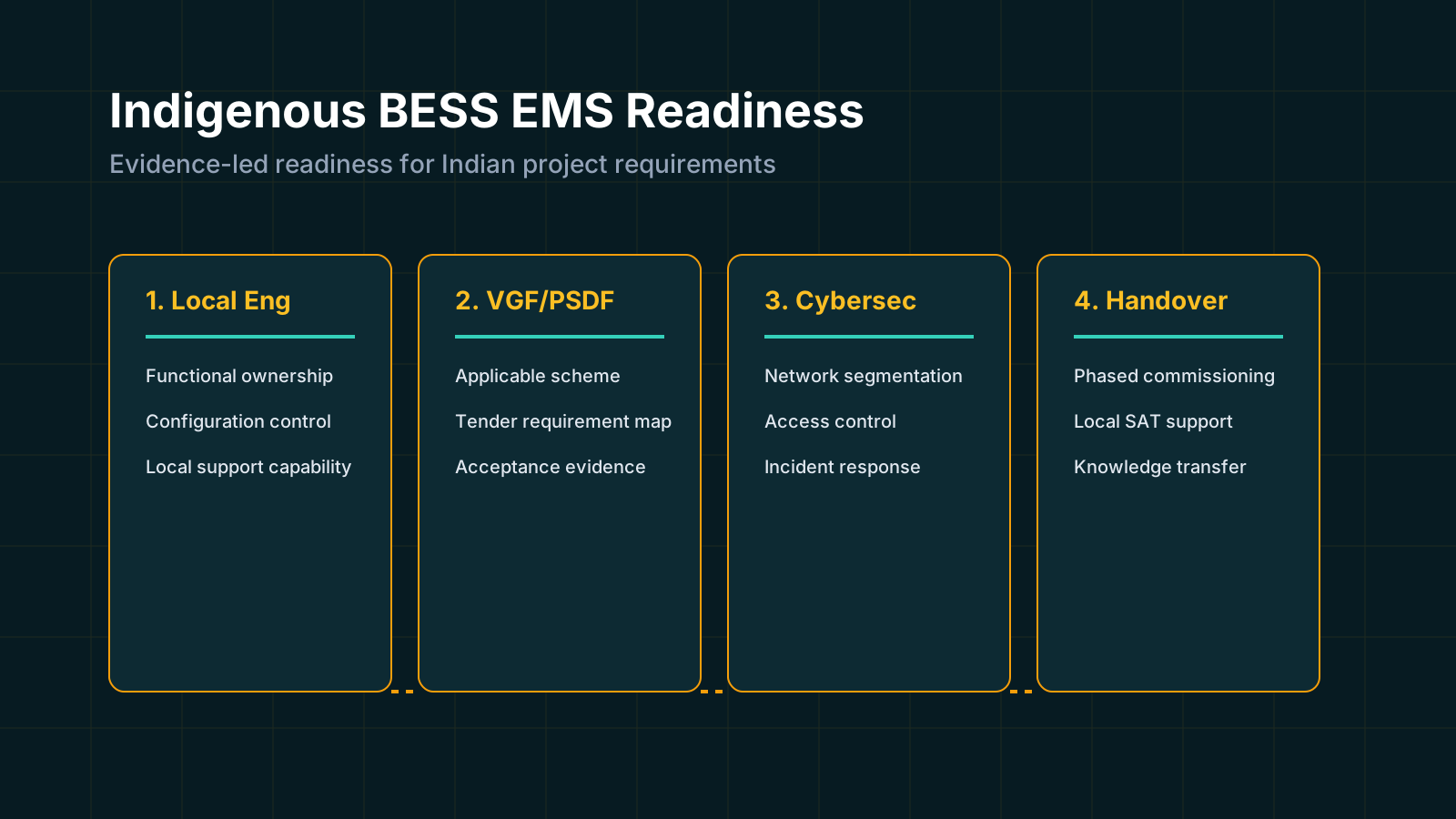
For this article, indigenous BESS EMS is a procurement-readiness concept rather than a universal legal definition. It is not defined merely by where the software company is incorporated. In a bankable project, “indigenous” is a practical question about control ownership, engineering capability, data governance, supportability, source-code or configuration access, cybersecurity, local commissioning and the ability to adapt the system to Indian grid and commercial requirements.
The exact eligibility and funding conditions depend on the active scheme, allocation route, procurer, tender and amendment in force at the time of application. The MNRE Energy Storage Systems policy hub lists the 2025 VGF scheme supported through PSDF, later amendments, state-component operating guidelines and related policy documents. Project sponsors should never treat a blog article as a substitute for the applicable notification, operational guidelines, RfS, BESPA/BESSA and sanction letter.
What VGF and PSDF are trying to solve
Viability-gap funding makes strategically useful storage projects financeable where service value is not yet fully reflected in contracted revenue. PSDF is a power-system development funding route. In the June 2025 VGF communication for BESS supported through PSDF, the Ministry of Power described an allocation covering 30 GWh of BESS capacity, with 25 GWh allocated to 15 states and 5 GWh to NTPC; it also specified a support amount expressed per MWh and asked states and NTPC to submit proposals to NLDC under the applicable operational guidelines.
Those figures belong to that specific government communication and are not an evergreen entitlement. They illustrate the opportunity’s structure: a designated implementing or procuring entity, defined storage capacity, support ceiling or formula, proposal process and operational requirements. A developer still has to satisfy active guidelines and the project’s tender and contract.
Public support is connected to a project that must be delivered, operated and demonstrated. A spreadsheet claiming “indigenous software” is not enough. As a practical bid-readiness recommendation, the project should prove safe operation, dispatchability, metering, availability, reporting and compliance at the contracted interface. The operative scheme and tender determine which items are mandatory.
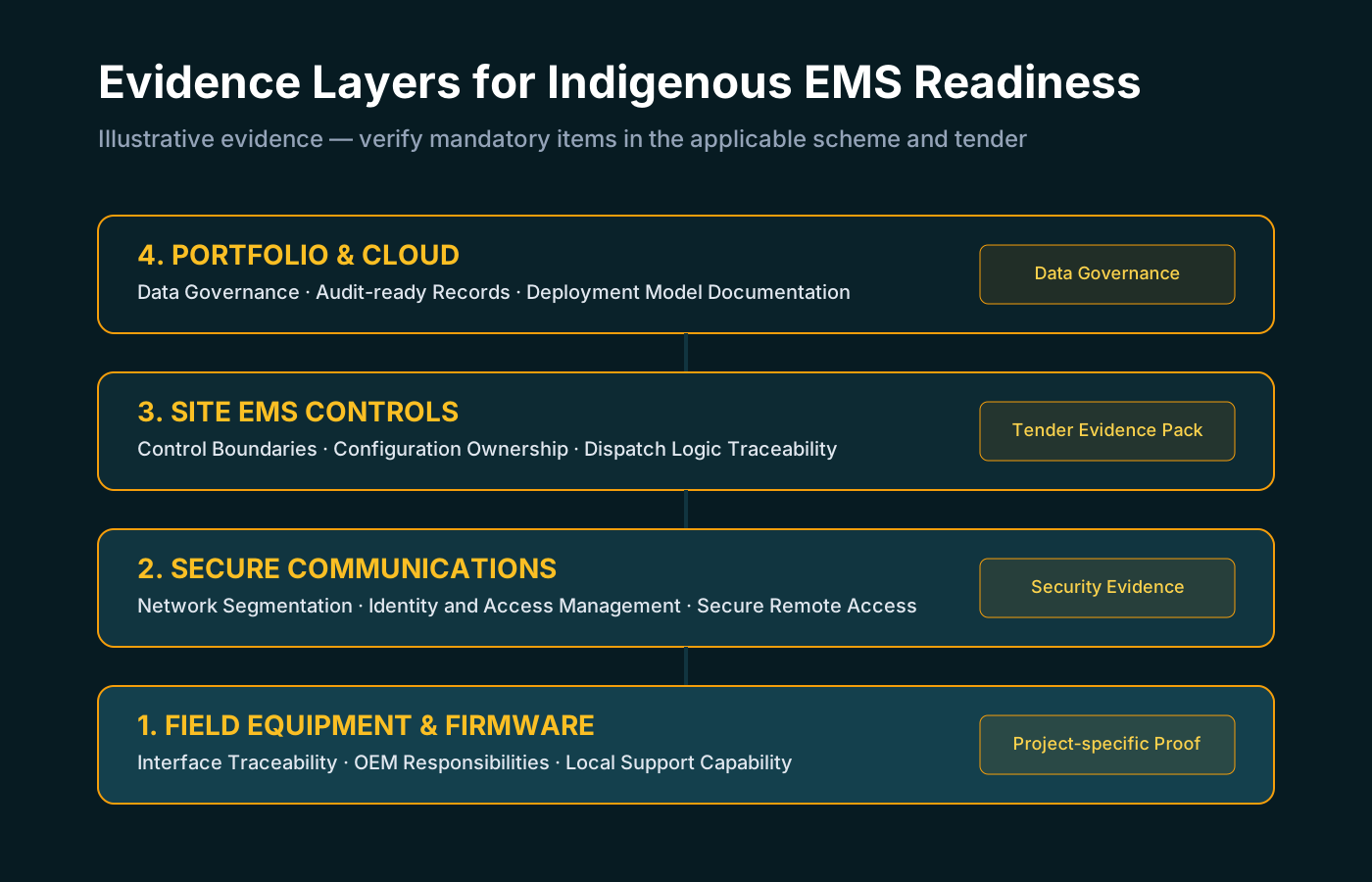
The seven evidence layers for an indigenous EMS
1. Functional ownership
Document which functions are genuinely owned by the Indian EMS team and which are licensed, embedded or OEM-dependent: schedule ingestion, SOC-aware dispatch, renewable coordination, reserve management, forecast handling, command arbitration, fallback modes, event logging, reporting and fleet aggregation. An EMS may interface with an imported BMS or PCS; indigenous control does not require replacing every power-electronics component. It does require a clear control boundary and a locally accountable integration, testing, security and support team.
2. Interface and protocol capability
Maintain a controlled interface catalogue for BMS, PCS, PPC, plant SCADA, revenue meters, weather systems, site loads, SLDC/RLDC/NLDC interfaces where applicable, and cloud or fleet services. Specify points, direction, data type, engineering units, quality flags, timestamps, scan rates, command priority and stale/invalid-data behaviour. SECI’s technical specifications identify BMS, PCS, data acquisition, communications and BESS EMS and assign integration responsibility between DC package, EMS, plant SCADA, AC package and grid commissioning. A local provider should turn this into a signed responsibility matrix.
3. Indian grid and market adaptability
Support schedules and revisions, state or regional control-centre interfaces, exchange or contracted instructions where permitted, ancillary-service requirements where eligible, availability declarations, meter reconciliation and deviation analysis. CERC regulations and amendments define deviation around actual versus scheduled injection or drawal. Grid-India’s published SRAS procedure adds AGC, bi-directional communication, SCADA telemetry, metering, performance assessment, cybersecurity, energy accounting and settlement. An indigenous EMS should be configurable for those processes, not hard-coded to a single pilot.
4. Cybersecurity and data governance
Document identity and access management, privileged-user controls, network segmentation, secure remote access, certificate/key management, logging, time synchronisation, backup and restore, patching, vulnerability handling, incident response and vendor remote-support procedures. A credible bid includes an architecture diagram, security-control matrix, data-flow map, hardening guide, account-management process, vulnerability disclosure route and test records. Map each tender requirement to a design feature and acceptance test.
5. Commissioning and performance proof
Prepare tests before deployment: local and remote control, priority, SOC and power limits, ramp rates, forecast error, telemetry loss, meter mismatch, PCS derating, BMS trips, emergency stop, restart, island/backup mode where relevant, time synchronisation and communications recovery. Grid-India/NLDC’s published SRAS procedure includes open-loop, closed-loop and performance-assessment procedures. A screen recording of a command is not evidence of end-to-end delivery at the point of interconnection.
6. Availability, degradation and warranty alignment
VGF projects may carry service obligations and contracted availability or dispatchability commitments, but exact requirements depend on the scheme, RfS and project agreement. Track usable energy, degradation, augmentation, outage states, auxiliary consumption, efficiency, reserve headroom and warranty-relevant throughput. Procurement specifications may define dispatchable energy at a point, year-by-year profile, round-trip-efficiency demonstration, availability and long-term service. The EMS must expose evidence without quietly consuming contractual reserve.
7. Local support and continuity
Show who responds when a plant cannot follow a schedule: Indian support team, escalation matrix, spare communications hardware, configuration control, training, local commissioning engineers, disaster recovery and transition plan if the integrator exits. Local support is operational risk management, not a marketing extra.
A VGF/PSDF readiness dossier
| Dossier section | Evidence to include |
| Company and product | Legal entity, product version, architecture, release process and support locations |
| Indigenous capability | Owned modules, Indian engineering team, configuration control and local commissioning |
| Integration | Interface register, protocols, point list, command arbitration and responsibility matrix |
| Grid compliance | Mapping to applicable CERC, Grid-India, SLDC/RLDC and project requirements |
| Cybersecurity | Network zones, IAM, remote access, logging, backup, patching and incident response |
| Performance | FAT, SAT, open/closed-loop, schedule-following, telemetry and recovery reports |
| Operations | NOC/support, training, spares, escalation and service-level commitments |
| Data and audit | Historian, time synchronisation, meter reconciliation, reports and exportable events |
| Commercial | Licence, warranty, change control, service term, liability and continuity |
What “indigenous” should not mean
It does not mean an Indian vendor may claim its software replaces OEM controls without evidence; ignore imported BMS/PCS interfaces; require every code component to be written in India when the tender does not; or assume public support mandates a particular commercial architecture. Indigenous value is demonstrated through control accountability, local engineering, adaptability, secure data handling, commissioning competence and long-term support. Active tenders may add domestic-content, procurement or qualification conditions; check the final RfS and contract.
Practical path and conclusion
Build evidence before the first large tender: use laboratory or hardware-in-the-loop environments; connect representative BMS, PCS, meter and SCADA interfaces; demonstrate schedule execution and safe rejection; produce FAT/SAT templates; build a cybersecurity pack; and run a pilot with measurable acceptance criteria. Convert the pilot into reusable bid evidence: reference architecture, test reports, availability dashboard, incident log, support records and an explanation of how the EMS improves dispatchability and visibility.
VGF and PSDF can reduce financing gaps, but public support does not remove execution risk. An indigenous EMS strengthens a project when it is locally accountable, interoperable, secure, testable and capable of supporting the contracted operating model. The procurement question is: can this EMS deliver, measure, secure and sustain the storage service being funded?
References
- MNRE, Energy Storage Systems policies and guidelines
- MNRE, VGF and energy-storage scheme resources
- CERC, current regulations and amendments
- CERC, current regulations governing scheduling and ancillary services
- SECI, tenders and technical specifications
For the adjacent operating question, see BESS dispatch scheduling in India, and for implementation evidence see the EMS commissioning checklist.