BESS Dispatch Scheduling in India: From Forecast and Bid to Metered Delivery
How Indian battery storage dispatch scheduling combines forecasts, SOC-aware optimisation, contracts, telemetry, metering and grid compliance.
By Shrikanto Nilange, Co-founder, Urja Matters · Battery Energy Storage · 13 minute read · Reviewed 2026-09-10
Dispatch is more than a charge or discharge command
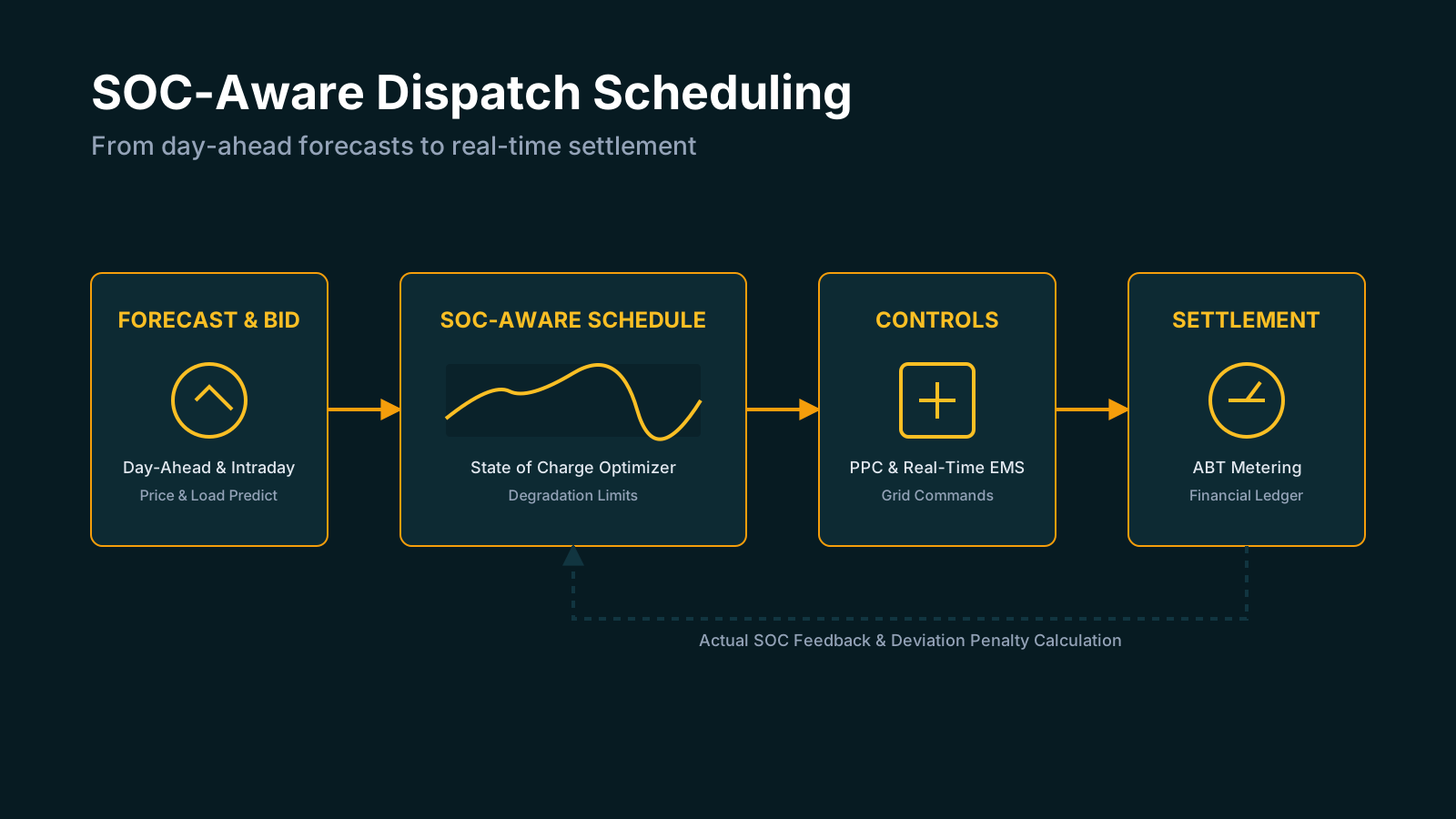
A BESS dispatch schedule is a time-indexed plan stating when the system should charge, discharge, hold energy or reserve capability. It is created within the project contract, market access, grid interface, battery limits and metering arrangement. The EMS converts it into executable setpoints through a PPC, PCS or plant controller while checking whether the plant can deliver them; BMS, protection and local interlocks may constrain or override commands.
An Indian BESS may be contracted for stored-energy delivery, capacity availability, renewable firming, peak shifting, ancillary services or several services. The revenue model determines what the schedule must protect, while regulation, procurer, state arrangement, market access and contract determine the available stack. A battery discharged for a short-term price may fail a later reserve obligation or evening block.
CERC’s regulations define scheduled and actual injection/drawal and schedule adherence within their stated scope. Distribution-connected or behind-the-meter systems may instead follow state, distribution, customer or project arrangements. Grid-India’s published SRAS procedure adds AGC, telemetry, metering, performance and settlement requirements for eligible participation; it is not universal.
Six inputs to an Indian BESS schedule
| Input | Why it matters |
| Contract and market instructions | Product, delivery window, availability, nomination and settlement |
| Renewable and load forecast | Surplus, deficit, curtailment and charging opportunity |
| Battery state | SOC, SOH, temperature, available power, usable energy, alarms and maintenance |
| Grid and plant limits | Point-of-interconnection, transformer, ramp, power factor and protection constraints |
| Price and opportunity value | Arbitrage or revenue stacking where legally and contractually permitted |
| Reserve and risk policy | SOC headroom, warranty, forecast error and unexpected instructions |
Retain timestamp and quality status for every input. A schedule built on stale SOC or invalid meter data is not robust.
The Indian operating sequence
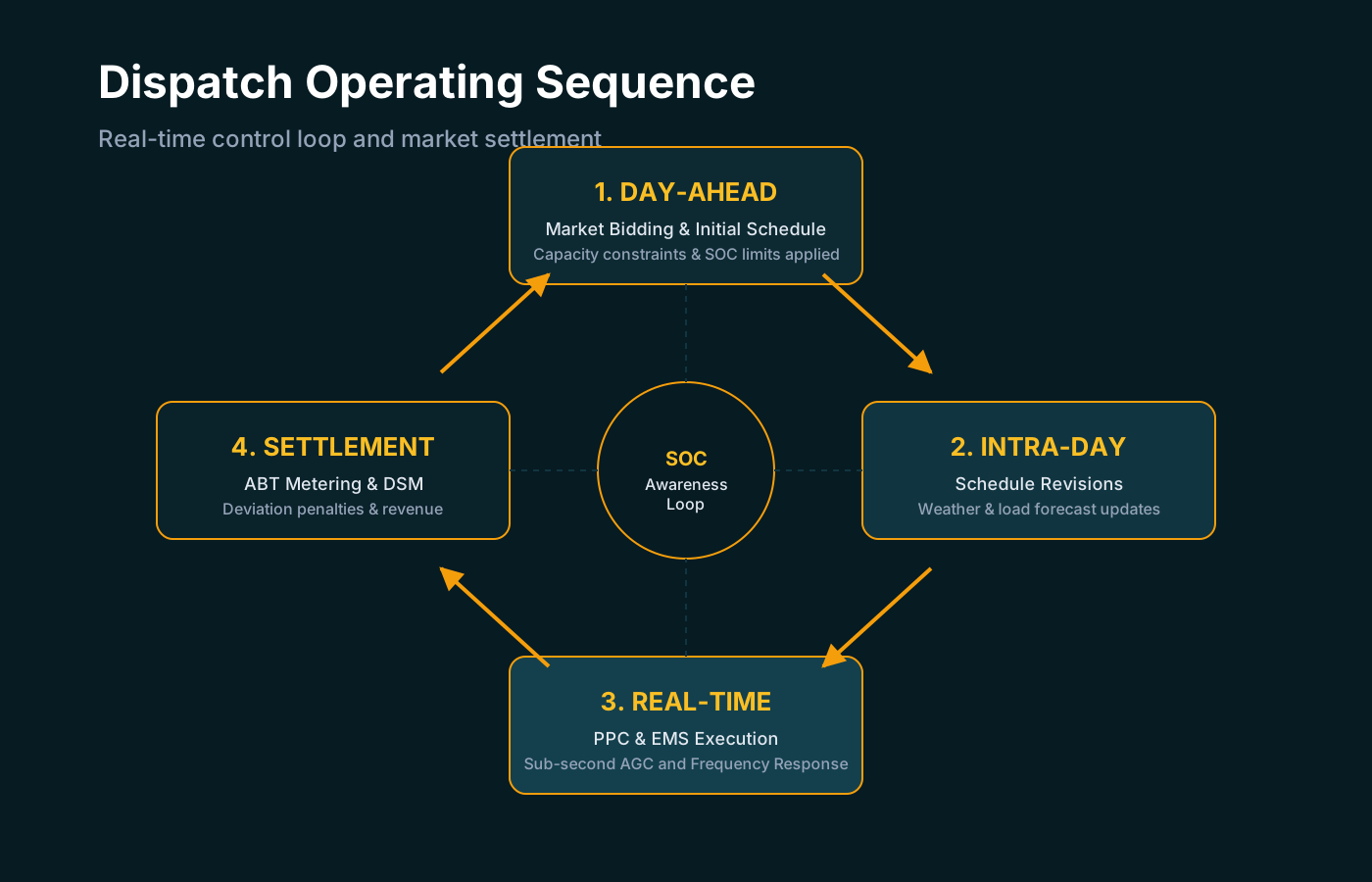
- Receive the obligation. Tag a storage agreement, renewable contract, utility instruction, exchange transaction, bilateral schedule, load objective or ancillary instruction with source, validity, priority and settlement consequence.
- Establish the feasible envelope. Calculate SOC bounds, charge/discharge power, thermal derating, auxiliaries, availability, ramp, response, minimum run/rest constraints and reserve headroom from BMS, PCS, PPC, transformer, protection, meter and plant data. Optimise for dispatchable energy at the contracted interface, not container energy.
- Forecast the horizon. Include solar/wind, load, prices, grid conditions, ancillary needs, temperature and equipment availability. Use scenario bands, reserve SOC, probabilistic forecasts or penalty-aware optimisation to represent error.
- Build the schedule. Maximise expected value = energy revenue + capacity/availability value + ancillary value − purchase cost − deviation exposure − degradation − auxiliaries, subject to SOC balance, power/efficiency, plant/ramp, contractual delivery, reserve, equipment/warranty, market and metering constraints. Rule-based and mathematical schedulers are both valid if explainable.
- Submit or communicate. Preserve submitted schedule, revisions, acknowledgements, rejections and final implemented schedule through the applicable procurer, utility, SLDC/RLDC/NLDC, exchange or scheduling coordinator. Technical capability does not imply market eligibility.
- Execute and re-optimise. Monitor output, SOC, meters, telemetry, alarms, response, ramp and communications. Re-plan on new instructions, forecast/price change, derating, BMS alarm, curtailment or deviation risk, distinguishing planned revision from control failure.
Ancillary services and SOC-aware dispatch
India’s ancillary framework includes secondary and tertiary reserve concepts under CERC regulations, subject to current procedures and eligibility. Grid-India’s SRAS procedure identifies NLDC as nodal agency, generates AGC signals, estimates reserve, specifies communications and metering, monitors response and supports accounting and settlement. Ancillary dispatch therefore requires reserved power and energy, time-stamped signals, specified response, telemetry and settlement reconciliation—not simply “turn the battery up.”
SOC-aware dispatch values stored energy across the remaining horizon. Ask: what SOC meets the next block; what energy/power is reserved; is charging now better than later; what is degradation cost; will temperature derate capacity; and should energy serve firming, peak reduction, reserve or trading? High SOC reduces charging headroom; low SOC reduces discharge capability. Operating range is project- and warranty-specific.
Scheduling, SCADA and the point of interconnection
Reconcile schedule and actual delivery at the commercial/grid interface, not only the container. A robust model retains:
| Data family | Examples |
| Schedule | Submitted, acknowledged, revised, implemented and settled |
| Actuals | Metered injection/drawal, PCS output, auxiliary consumption and SOC |
| Constraints | BMS, PCS, PPC and transformer limits; communications state |
| Events | Trip, derating, curtailment, emergency stop, rejection and recovery |
| Commercial | Bid, contract, availability, delivery, deviation and settlement value |
| Audit | User, timestamp, source, version, approval and change reason |
Common failures are confusing forecasts and obligations; confusing DC energy, PCS output and point-of-interconnection delivery; using an unexplained SOC; missing time synchronisation; failing to reconcile SCADA and revenue meters; insufficient reserve; poor revision handling; no communications fallback; ignoring auxiliaries; and allowing unaudited optimiser changes.
Practical checklist
- Is the scheduling and settlement entity defined?
- Are CERC, Grid Code, SLDC/RLDC/NLDC, exchange and contract requirements mapped?
- Are meters, time bases, quality flags and interfaces defined?
- Does the engine respect BMS, PCS, PPC, transformer and contract limits?
- Can it reserve energy and power for ancillary/availability obligations?
- Are submitted, acknowledged, revised and implemented schedules stored?
- Can deviation be detected and explained before settlement?
- Are telemetry loss, derating, trip, restart and emergency modes tested?
- Are cybersecurity, remote access and operator approvals documented?
- Can it produce an auditable performance and settlement report?
References
- CERC, current regulations including DSM
- CERC, ancillary-services regulations and amendments
- SECI, BESS tenders and technical specifications
For architecture boundaries, read BESS EMS architecture; for the evidence gate, read the commissioning checklist.