BESS, Storage Use Cases for Indian Grid and the Role of EMS
A use-case-led view of storage value, deployment conditions, and the role of EnergyXEMS across India’s evolving grid.
By Madhusudan Chakrapani, Cofounder, Urja Matters · Battery Energy Storage · 23 minute read · Reviewed 2026-09-10
Executive perspective
India’s storage opportunity is becoming more concrete, but a battery is not a single-use asset and an EMS is not a generic revenue engine. India had 300.50 GW of non-fossil generation capacity as at 31 July 2026, including 164.59 GW of solar and 58.14 GW of wind.[2] This scale of variable generation is increasing the need for flexible resources, but the benefit available from a battery depends on the point of connection, contracted service, interconnection limits, grid conditions, operating rules, metering, dispatch approvals and payment or settlement arrangements.
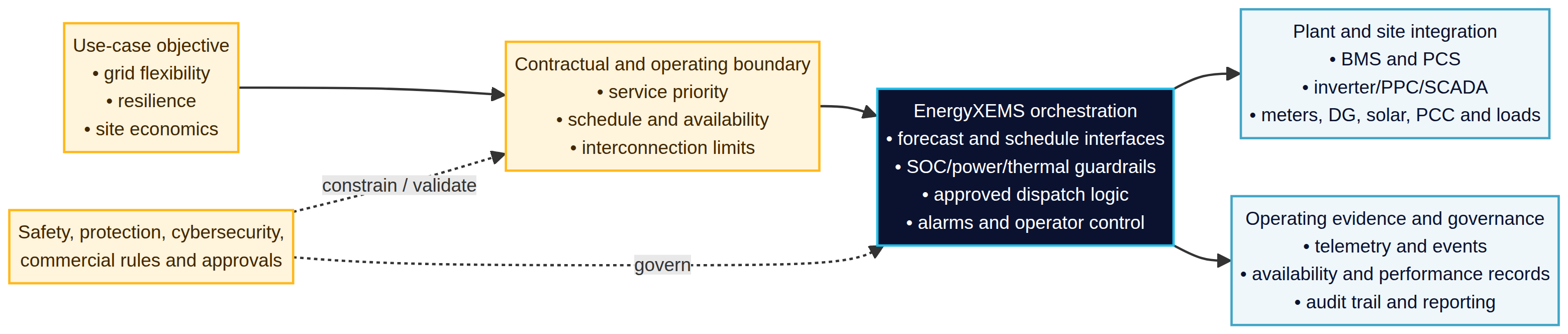
The central insight is therefore simple: storage value is location- and service-specific. A BESS placed at a renewable pooling point to absorb constrained generation, a standalone BESS procured by a distribution company for peak demand, a microgrid battery protecting priority loads, and a C&I battery operating behind a facility meter may use similar hardware. They require very different decisions, control boundaries, interfaces and operating evidence. An Energy Management System (EMS) is the control-and-evidence layer that turns those project-specific requirements into disciplined daily operation.
Core proposition. An EMS should be specified from the operating service backwards: first define the service, commercial and safety boundaries; then design the control logic, data interfaces, operator workflow and evidence required to execute that service reliably.
The policy signal is strong. The Ministry of Power identifies BESS and pumped storage as resources for frequency control, voltage regulation, peak shifting, congestion management and black-start support, while resource-adequacy planning places energy storage within a broader reliability framework.[11] CEA’s Phase II national workshop similarly highlighted arbitrage, ancillary services, reactive-power support, congestion management, blackout support, distribution support and DG-set replacement as relevant BESS applications, alongside the need for monitoring, cybersecurity, protection and emergency preparedness.[15] These references establish the use-case landscape; they do not establish that every project can stack every service or that an EMS alone can guarantee revenue, compliance or savings.
1. Why India’s storage opportunity is an EMS opportunity
Flexibility must be matched to the constraint it is intended to relieve
Recent evidence reinforces the importance of addressing the right constraint. Ember estimated 470 GWh of interstate-grid renewable curtailment in Q1 2026, including 300 GWh linked to transmission constraints; it suggested that 3–4 GW of two-hour BESS at pooling stations could absorb much of that curtailed energy.[4] This is an analytical estimate, not an official national curtailment series, and it should not be translated into a project-level energy or revenue promise. Its relevance is nevertheless operationally important: a BESS meant to relieve renewable curtailment needs forecast-informed charge windows, export constraints, grid dispatch interfaces and availability evidence. A battery installed elsewhere may not solve the same constraint.
Government planning documents likewise describe an expanding storage requirement but use different scopes and planning vintages. A 2026 Ministry of Power release cited 47.24 GW / 236 GWh of BESS by 2031–32 in the National Electricity Plan context, while a December 2025 release cited about 336 GWh of total storage by 2029–30 and 411 GWh by 2031–32.[4] [11] A February 2026 MNRE release cited 60.63 GW of storage capacity by 2029–30, including 41.65 GW of BESS.[10] These figures should not be added together; instead, they show that the Indian power system is planning for materially more flexible capacity and that the delivery model will matter as much as the asset volume.
The commercial context is changing as well. The Government has described VGF support across two schemes amounting to about 43 GWh and has provided qualifying ISTS-charge waivers for co-located BESS projects under stated conditions.[10] [11] Secondary reporting of an IESA market review placed operational BESS at 8.5 GWh in H1 2026 and reported a significant merchant-mode share; this is useful market context but should be validated against the primary IESA publication before use in investment models.[12] For EMS design, the implication is clear: more projects will face combinations of contractual dispatch, market signals, availability requirements and operational reporting. The EMS must preserve the operating headroom needed for the highest-priority obligation rather than blindly pursue the most recent signal.
| Indian system condition | Storage response that may be relevant | What must be true before value can be claimed | EMS contribution |
| Solar- or wind-led variability | Charge during excess generation; discharge into defined windows | A viable interconnection, schedule, nominated delivery window and acceptable operating envelope must exist | Ingest forecasts and schedules; apply SOC, power and thermal limits; issue bounded dispatch instructions; retain performance evidence |
| Transmission or local congestion | Local absorption or export shaping | The battery must be electrically and contractually positioned to address the constraint; transmission reinforcement may still be required | Apply export/import limits, curtailment-response logic and event records; coordinate approved set-points with plant/PPC/SCADA |
| Peak-demand and resource-adequacy need | Discharge during a defined system or feeder peak | The capacity, duration, availability and procurement terms must match the peak obligation | Maintain readiness, reserve SOC, track availability and issue planned or approved real-time discharge commands |
| Frequency, voltage or reactive-power need | Fast power response and/or reactive support | Ancillary-service eligibility, performance tests, telemetry, communications and system-operator instructions are required | Execute validated control modes within equipment limits; ingest approved signals; time-stamp response and availability evidence |
| Resilience or black-start requirement | Maintain priority loads or restore agreed electrical islands | Protection, sequencing, source availability, local studies, testing and site procedures must be validated | Coordinate source priorities and staged load restoration; present alarms, interlocks and operator controls; maintain event history |
Storage does not replace the grid investment it depends on
The primary article’s argument—that India can fund batteries without simultaneously resolving all grid constraints—deserves to shape both deployment strategy and messaging.[1] A BESS can absorb, shift or provide fast response at a useful location. It does not automatically create transmission capacity, eliminate protection constraints, substitute for all network investment or make every RE project dispatchable. The same discipline applies to EMS: it can coordinate approved schedules and assets, but it cannot correct an undersized transformer, override grid-code requirements or guarantee access to a market product.
For this reason, the first EMS deliverable is often operating clarity: which asset has authority, which signals are binding, which limits are hard, who can override, which state of charge is reserved for a contracted service, and how performance is evidenced. Those answers differentiate a control system designed for a real use case from a dashboard with battery data.
2. The principal BESS and storage use cases in India
2.1 Renewable-energy shaping, peak-hour supply and firm-delivery products
The most visible storage use case is shifting variable renewable energy into a later delivery period. Indian policy releases specifically note increasing interest in solar/wind-plus-storage, peak-hour supply and firm-and-dispatchable renewable-energy configurations.[10] The value proposition is not simply “store cheap solar and sell expensive power.” It is the ability to deliver an agreed profile, preserve availability, manage the cycling implications of the service and document whether nominated delivery was achievable within the plant and grid operating boundary.
For a utility BESS, the EMS must combine forecast and schedule ingestion with a real-time closed loop around BMS, PCS/inverters, plant controller, meters and grid/SCADA interfaces. It should reserve SOC for committed periods, prevent commands outside approved SOC, power, temperature or degradation boundaries, expose curtailment or grid unavailability as an operational condition, and produce event and availability evidence. Advanced optimisation can improve dispatch quality, but it must remain subordinate to contracted obligations, asset limits and approved market procedures.
2.2 Congestion relief and renewable-curtailment mitigation
BESS may be deployed near renewable pooling stations, substations or constrained distribution areas to absorb energy that cannot otherwise be evacuated or locally consumed. Ember’s Q1 2026 estimate makes the spatial nature of this use case explicit.[4] In such projects, the critical distinction is between energy available to charge and energy legally and electrically deliverable on discharge. A BESS may reduce local curtailment while still facing a later export constraint if the underlying network condition has not changed.
A BESS EMS therefore needs explicit import/export limits, curtailment and grid-state inputs, forecast-aware charging priorities, plant-controller coordination and transparent operator override. Its reports should distinguish unavailable generation, grid constraint, asset constraint, control hold and planned reserve. These records support operational learning and stakeholder dialogue; they should not be represented as proof that curtailment was eliminated.
2.3 Ancillary services, frequency response, voltage regulation and reactive support
The Government has stated that ESS are eligible for secondary and tertiary reserve ancillary services under the applicable CERC framework, subject to specified conditions, and it describes frequency control and voltage regulation among the intended system roles for storage.[11] CEA’s workshop also refers to reactive-power support and ancillary services as part of potential value stacking.[15]
These services are technically demanding because speed, signal quality, measurement, telemetry, SOC availability, operating mode, inverter capability and restoration logic all matter. The EMS role is to coordinate approved service modes, maintain SOC headroom, validate inputs, manage transitions between modes, observe equipment and plant limits, log response and present alarms or exception states. Protection coordination, system-operator approval, communications performance and ancillary-market eligibility remain outside the EMS alone and must be validated per project.
2.4 Peak-demand management and resource adequacy
Standalone BESS is increasingly being considered by DISCOMs and state utilities as a capacity and flexibility resource. CEA’s workshop references the roles of BESS in peak-demand management, renewable integration, grid flexibility and localised energy storage, while broader policy has embedded storage in resource-adequacy planning.[11] [15] The core need is dependable discharge during defined stress periods—not simply high annual throughput.
The appropriate EMS behaviour is conservative and transparent. It should calculate or display available deliverable capability, preserve the agreed SOC reserve, respect duration and thermal constraints, manage planned charge recovery, provide availability reporting and show the reason for any service non-readiness. This turns the EMS into the operating record for an asset whose economic value may depend on a limited number of critical hours.
2.5 Black-start preparedness, resilience and microgrid continuity
Black-start support is listed by the Ministry of Power as a potential storage role, and CEA workshop materials cite blackout support and the use of BESS in critical infrastructure.[11] [15] In practice, this category spans many different projects: a grid-connected BESS held for restoration support, a campus microgrid with islanding capability, a hospital or data-centre resilience scheme, or an industrial facility reducing dependence on diesel backup.
The EMS must distinguish a simple backup sequence from a true islanding or restoration scheme. For a validated microgrid, it may coordinate source-priority logic, DG start/stop interface, solar curtailment, SOC reserve, non-critical-load shedding, staged reconnection and synchronisation visibility. It must not be marketed as a substitute for the project-level studies and factory/site testing required for protection, anti-islanding, synchronisation, communication latency, field interfaces and cybersecurity. Those are engineering and validation obligations, not software features.
2.6 C&I demand, procurement, backup and power-quality use cases
For C&I sites, storage is often evaluated through a combination of demand management, resilience, rooftop-solar self-consumption, DG displacement, green-power procurement and operational evidence. CEA’s workshop documents a case-study context for DG-set replacement through rooftop solar and BESS and encourages its consideration where techno-economic feasibility is established.[15] It is not a blanket conclusion that BESS will economically replace every DG set.
A C&I EMS should integrate the site’s meters, BESS, solar, DG, PCC and priority loads around approved dispatch and load-priority rules. It can provide tariff-window awareness, demand and import visibility, SOC-aware backup reserve, alarm management, user roles and auditable reports. Where a site has RE and non-RE open-access supply, the EMS can present the portfolio and associated schedules subject to the customer’s metering, contract and data scope. Commercial optimisation, settlement workflow integration and enterprise reporting should be treated as separately scoped modules whose performance depends on tariff structure, market rules, data quality and operating approvals.
| Use case | Primary decision | Natural EnergyXEMS context | EMS control and evidence role | Essential qualification |
| Renewable shaping / peak-hour delivery | When to charge and discharge to meet a nominated profile | BESS EMS | Forecast and schedule interface, SOC guardrails, dispatch, plant integration, delivery and availability records | Contract, grid access, duration, forecast quality and plant performance determine feasibility |
| Pooling-point curtailment response | When and how much renewable energy can be absorbed locally | BESS EMS | Import/export limits, curtailment state, PPC/SCADA coordination, exception reporting | BESS siting does not remove the need for adequate downstream evacuation |
| Ancillary / frequency / voltage support | Which validated response mode has priority | BESS EMS | Mode management, signal validation, reserve SOC, limit enforcement, response logs | Eligibility, performance tests, telemetry and operator instructions are service prerequisites |
| Peak-capacity readiness | How much dependable capability is available at defined peak hours | BESS EMS | Reserve calculation, readiness status, planned recovery, availability evidence | Resource-adequacy value depends on procurement and system requirements |
| Priority-load continuity | Which loads and sources retain service during an event | Microgrid EMS | Source priority, SOC reserve, DG/solar/BESS coordination, staged load logic, event trail | Protection, islanding, synchronisation and field interfaces require project validation |
| DG mitigation / site backup | How to reduce diesel operation while maintaining required backup | Microgrid EMS or C&I EMS | Backup reserve policy, source transitions, load-shed sequence, runtime/event records | Financial and resilience outcomes are site-specific and must be validated |
| C&I procurement and cost visibility | Which supply source and operating schedule is preferred | C&I EMS | Supply-portfolio visibility, schedule ingestion, tariff/demand analytics, approved dispatch logic | Savings, settlement and compliance outcomes cannot be promised without site-specific validation |
| Multi-site operations and governance | How to compare performance and manage exceptions across assets | BESS, Microgrid or C&I EMS with selected advanced modules | Role-based access, alarms, historian/cloud integrations, portfolio views and audit evidence | Data architecture, cybersecurity and enterprise integrations require separate scope |
3. What an EMS must do for the use case to be deliverable
Translate intention into a safe, bounded operating envelope
A battery’s physical state is not enough. The EMS needs a usable representation of what the battery is allowed to do next. This includes SOC, charge/discharge power, thermal and BMS constraints, derates, remaining duration, reserve commitments, grid or site limits, approved schedules, mode status and interlocks. For some deployments, degradation-cost or health inputs may inform operating recommendations; the model, warranties and acceptance criteria must be agreed separately.
The CEA workshop’s operational lessons highlight documentation, communication infrastructure, protection, monitoring and alarms, data sharing, cell-level analytics and annual capacity testing as parts of the BESS operating context.[15] An EMS should support the visibility and evidence needed by these workflows. It should not claim to replace BMS protections, PCS firmware, fire suppression, electrical protection, emergency response or independent safety assessment.
| EMS capability layer | Operational question it answers | Examples of functions | Evidence produced |
| Plan | What is the target operating profile and what must be reserved? | Forecast and schedule ingestion, dispatch plan, service priority, SOC targets | Plan-versus-actual and reserved-capability views |
| Control | What command is permitted now? | Approved set-points, source priority, import/export limits, ramp and mode logic | Command history, interlock/limit states, operator actions |
| Observe | Is the plant/site healthy and ready? | Telemetry, alarms, communication status, SOC/power/thermal visibility, availability state | Events, downtime classifications, availability and response records |
| Prove | Can the operating result be explained and audited? | Meter/schedule reconciliation views, reports, audit trail, historian/cloud interfaces as selected | Time-stamped performance, exception and user-action records |
| Govern | Who can change what, and how is risk managed? | Role-based access, approval workflow, cyber controls, configuration/version records | Access and configuration logs; security and change-management evidence |
Manage priorities rather than optimise in isolation
The most consequential EMS design choice is often its priority stack. A utility BESS with a peak-delivery obligation may not have the freedom to pursue merchant arbitrage on the same day. A microgrid held for critical-load resilience cannot spend its reserve serving a non-critical load without an approved rule. A C&I site using BESS for demand control must preserve sufficient energy for the backup policy that the site has chosen.
An EMS should make this priority explicit and reviewable. Typical hierarchy can be: safety and protection first; contractual/grid/operator instructions next; resilience or critical-load reserve next; approved commercial or optimisation functions after that. The hierarchy, transition conditions and override authority must be established during engineering and commissioning. They cannot be inferred from a dashboard or added later without considering asset, grid and customer consequences.
Use data interfaces as operational dependencies, not decoration
Storage projects are data-intensive: BMS/PCS states, metering, weather/RE forecast, SCADA/PPC, load, DG, grid dispatch, market/schedule systems, historian and enterprise applications may all contribute. The EMS must have a clear, approved interface matrix covering protocol, data ownership, refresh rate, quality flags, clock synchronisation, authority, fail-safe behaviour and cybersecurity. The product interface landscape can include IEC 61850, IEC 60870-5-104, ICCP/TASE.2, DNP3, Modbus TCP/IP and RTU, OPC UA/DA, MQTT, APIs, SFTP/FTP, ODBC, Profinet, CAN and M-BUS, but availability of any interface depends on the supplied equipment and approved project scope.
India’s 2026 fire-safety training guidance explicitly includes software reliability and cybersecurity risks alongside BMS, thermal management, electrical and emergency-response topics.[14] The correct implication is that EMS architecture needs secure deployment, role-based access, network segmentation, controlled remote access, change management and event records appropriate to the plant or site. It is not an assertion that software alone fulfils the complete BESS safety or cybersecurity obligation.
4. Contextualising the role across the three EnergyXEMS variants
EnergyXEMS for BESS: disciplined plant control with an extensible market interface
BESS EMS is the disciplined plant-control foundation that can extend as a market interface to unlock portfolio value. Its core purpose is to keep a grid-connected or utility-scale BESS within an approved operating envelope while translating forecasts, schedules, plant states and authorised instructions into operating actions and traceable evidence. It is suited to renewable shaping, contracted peak-hour supply, congestion response, ancillary-service readiness, resource adequacy and—where the project is designed for it—market participation.
The base system should include asset integration, real-time monitoring and approved plant control, day-ahead dispatch forecasting, SOC management, degradation-aware operating inputs where scoped, analytics/alerts/reporting, operational support and secure deployment. It should integrate as approved with BMS, PCS/inverters, SCADA, meters, forecasting and scheduling systems. On-demand modules may extend the platform with cloud data storage, historian, enterprise workflows, multi-site views, advanced forecasting, AI-based analytics/health insights, merchant power-sale automation and revenue optimisation. Those modules do not override service priorities, market rules, grid constraints or asset warranties.
EnergyXEMS for Microgrids: priority-led control and power backup, scalable to multi-site insight
Microgrid EMS is the priority-led control and power-backup foundation that can scale to provide operational insight across sites. The central use case is not battery arbitrage in isolation; it is the coordinated operation of solar/renewables, BESS, PCC/grid, DG and priority loads within an agreed resilience strategy. The EMS makes the strategy observable and executable through approved source-priority logic, SOC-aware control, alarms, user roles and audit trails.
Its value is most evident where continuity, source selection, backup policy and controlled transitions are material: campuses, critical services, remote or weak-grid sites, commercial facilities and industrial microgrids. The base system covers approved interfaces to BMS, PCS, SCADA, meters, protection and DG; on-demand modules can add cloud/historian capability, enterprise views, CMMS/ERP links, customer dashboards and advanced optimisation after validation. Project engineering remains decisive. Protection coordination, islanding, synchronisation, field interfaces, response latency, anti-islanding, communications performance and cybersecurity must be validated for each site before any resilience or transition behaviour is relied upon.
EnergyXEMS for C&I: control, procurement and backup with a path to validated optimisation and reporting
C&I EMS is the control, Procurement and backup foundation that can extend to power cost optimization and enterprise reporting. It integrates facility assets—such as rooftop solar, RE and non-RE open-access supply where applicable, BESS, DG, facility bus, meters and critical loads—around approved dispatch/load-priority rules. The primary output is credible operational visibility: what power was available, what was used, what reserve remained, what exception occurred and which action was taken.
The base system can provide real-time monitoring and alarms, role-based access and audit trail, SOC-aware control, reporting and analytics, and secure on-premise/cloud/hybrid deployment. It can support schedule ingestion, time-block schedule-versus-actual visibility, exception alerts and auditable metering/reporting views where customer scope requires. In Karnataka, any KERC DSM-related workflow must remain explicitly conditional because the regulation is draft: final applicability, thresholds, charges, scheduling process and settlement methodology must be verified against the notified framework and the customer’s commercial arrangements. The EMS must not promise compliance, settlement accuracy, penalty avoidance or savings.
On-demand C&I modules include cloud data storage, historian, enterprise integration, portfolio dashboards and tariff/demand/commercial optimisation after site validation. These can convert operational data into a decision support capability, but cost optimisation depends on tariff design, supply contracts, open-access rules, metering, data quality, load flexibility and approved operational policies.
| Decision criterion | BESS EMS | Microgrid EMS | C&I EMS |
| Primary operating question | How can the battery meet its defined grid or market service within plant limits? | How can sources and loads maintain the agreed priority and continuity outcome? | How can site supply, backup and demand be made visible and controlled within commercial and operational boundaries? |
| Typical asset boundary | BMS, PCS/inverters, PPC/SCADA, meters, RE plant, forecast and dispatch systems | Solar/RE, BESS, PCC, DG, meters, protection and priority loads | Rooftop solar, RE/non-RE open access where applicable, BESS, DG, facility bus, meters and critical loads |
| Highest-value base capability | SOC-aware dispatch, plant control and availability evidence | Source-priority and resilience logic with auditable event handling | Supply/backup/demand visibility with approved dispatch and operating evidence |
| Advanced-extension logic | Market interface and portfolio optimisation after rules and controls are validated | Multi-site insight and advanced optimisation after protection/transition validation | Enterprise reporting and commercial optimisation after tariff, contract and data validation |
| Non-negotiable project gate | Grid/service eligibility, connection, performance testing and equipment limits | Protection, islanding, synchronisation, field interfaces, latency and cybersecurity validation | Metering, tariff/contract rules, site operating policy, backup needs and regulatory applicability |
5. Implementation priorities and decision rules
A credible Indian storage project should start with a use-case charter, not an EMS feature list. The charter should name the service; identify the buyer, counterparty and operating authority; define electrical location and meter boundary; state the duration, availability and reserve expectation; identify binding grid/site limits; describe the data and interface dependencies; and establish the evidence expected after operations begin. The EMS functional specification should then convert this charter into operating modes, priority logic, alarm states, operator workflows, reporting and cybersecurity controls.
The project should also make value stacking deliberate. The CEA workshop encourages consideration of multiple BESS use cases, but stacking is feasible only when the asset has sufficient power, energy, interconnection capability, telemetry and commercial permission after meeting its highest-priority obligation.[15] The EMS supports this by maintaining a transparent priority hierarchy and by showing the SOC/availability consequences of any proposed action. It does not create additional battery duration or contract rights.
Safety and lifecycle readiness should be designed in from the outset. The 2026 CEA/DGFS guidance includes emergency plans, site familiarisation, fire-service engagement, technical documentation, drills and records among owner/operator responsibilities.[14] The Battery Waste Management Amendment Rules, 2025 address EPR registration information and related marking conditions; they do not prescribe EMS functions.[16] An EMS can improve data access, condition/event history and traceability where scoped, but fire protection, emergency response, recycling, EPR and compliance remain shared equipment-, owner-, regulator- and contractor-specific responsibilities.
Finally, the document’s use-case framework should guide claims discipline. Storage can enable flexibility, but the realised outcome remains conditional on site studies, contracts, tariffs, grid-code and regulatory requirements, market access, technology performance, warranty/degradation constraints and operations quality. The right message is not that EMS guarantees value; it is that an appropriately engineered EMS makes storage use cases controllable, observable and auditable—thereby giving the asset a credible operating pathway to deliver the service for which it was built.
6. Research scope, source limitations and references
This document reviews the primary article and all sixteen references linked in it. Factual claims above are attributed to the cited sources, with official Government and CEA documents used preferentially where available. Two linked references require caution: the CEA workshop report is an informational workshop report that itself advises cross-checking, and the linked RPO/ESO document returned a mismatched parliamentary PDF during review. The latter is listed for completeness but is not used for any specific trajectory value. Ember, IEEFA, ORF and Power Peak/IESA materials are analytical or secondary sources and are distinguished from official policy sources.
Prepared for discussion and use-case definition. This is not grid-operation, safety, regulatory, commercial, investment, or legal advice. Project requirements, codes, approvals, tariffs, schedules, settlement rules, interfaces and operating responsibilities must be validated by the responsible owner, engineering, safety and regulatory parties.